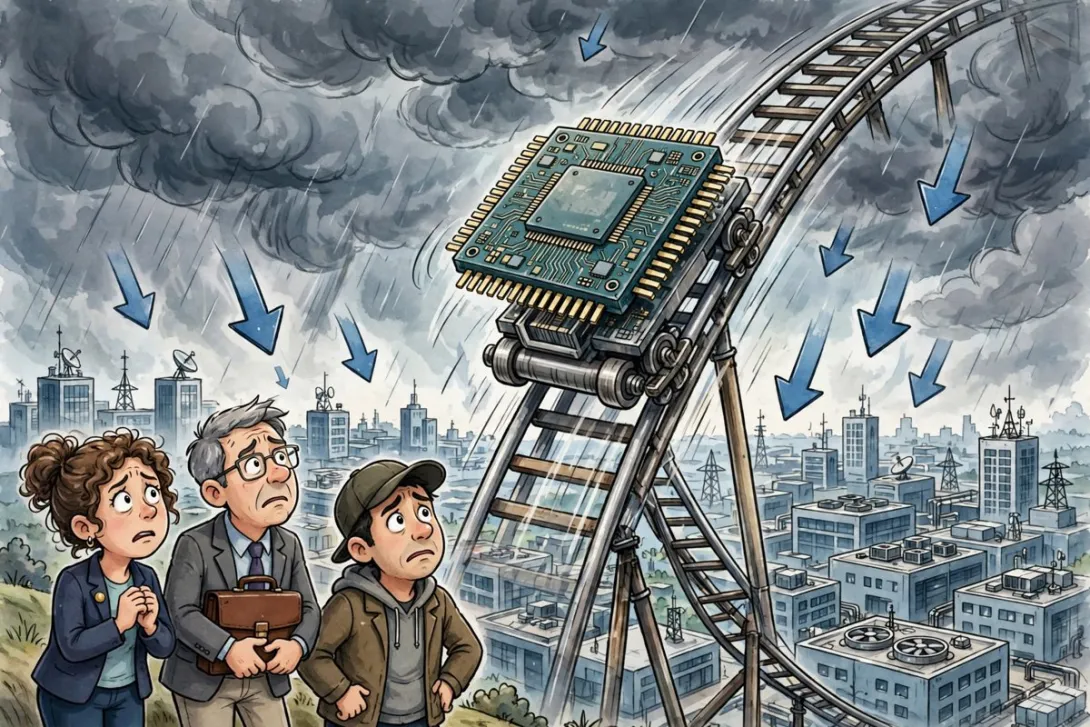
U.S. semiconductor stocks were set to lose about $2 trillion in market value on Thursday, extending a steep selloff that had already erased $1.64 trillion over the previous six trading sessions, according to Reuters.
The Philadelphia SE Semiconductor Index was down 3.3% in Thursday trading in the initial Reuters report, capping a week in which investors reassessed both the price of the artificial intelligence boom and the cost of financing it. Rising bets on a Federal Reserve interest-rate hike added pressure, because higher borrowing costs weigh most heavily on capital-intensive projects and on highly valued growth stocks.
The selling was not confined to chip designers. Reuters reported that debt concerns also hit data center operators and other companies tied to building and financing AI infrastructure. That breadth matters for enterprise buyers. The AI buildout depends on a chain that runs from chipmakers and equipment suppliers through power, cooling and networking to operators who must borrow to put new capacity in the ground. When financing that chain looks more expensive, the whole chain reprices at once.
The rout was global. In a later Reuters update from New York, global markets were flat overall while technology and chip stocks continued to fall. The Philadelphia index was last down 1.7% in that update, while the Dow Jones Industrial Average rose 1.08%, the S&P 500 rose 0.27% and the Nasdaq Composite rose 0.11%, helped by healthcare and materials. In Asia, South Korea's KOSPI index plunged almost 8% and Japan's Nikkei 225 fell nearly 5%. MSCI's broadest index of Asia-Pacific shares outside Japan closed 3.12% lower, its biggest one-day drop since late July, while European stocks recovered early losses to finish up 0.38%.
Commentators cited by Reuters pointed to valuation and to questions about the sustainability of demand for data centers, rather than to a collapse in underlying demand for chips. That distinction is important. Earlier this week, equipment maker ASML raised its 2026 forecast again as demand for advanced chipmaking tools outran planned supply, a sign manufacturers still expect AI demand to keep production lines busy. Thursday's move was about returns and funding, not factories suddenly going quiet.
For IT leaders, the practical takeaway is timing and leverage, not panic. A selloff driven by rate expectations and stretched valuations does not make servers cheaper overnight, and it does not cancel build plans already under contract. It can change negotiating conditions in the months ahead. Vendors and operators facing higher capital costs may become more flexible on pricing, financing and delivery schedules to keep utilization high, while customers with approved budgets may find counterparties more eager to lock in commitments.
Bond markets underlined how unsettled the rate picture remains. Reuters reported benchmark 10-year U.S. Treasury yields fell back toward 5% in their biggest daily drop in more than a year, down 10.29 basis points at 5.087%. Fed funds futures priced a 73% implied probability the Federal Reserve will stay on hold at its meeting ending October 28, according to CME Group's FedWatch tool cited by Reuters.
Whether Thursday marks a turning point or another leg down will depend on earnings, guidance and the Fed. What is clear is that the AI infrastructure trade is no longer priced on demand alone. Investors are now pricing the debt, the power and the time it takes for that spending to pay back, and on October 15 that repricing was severe.