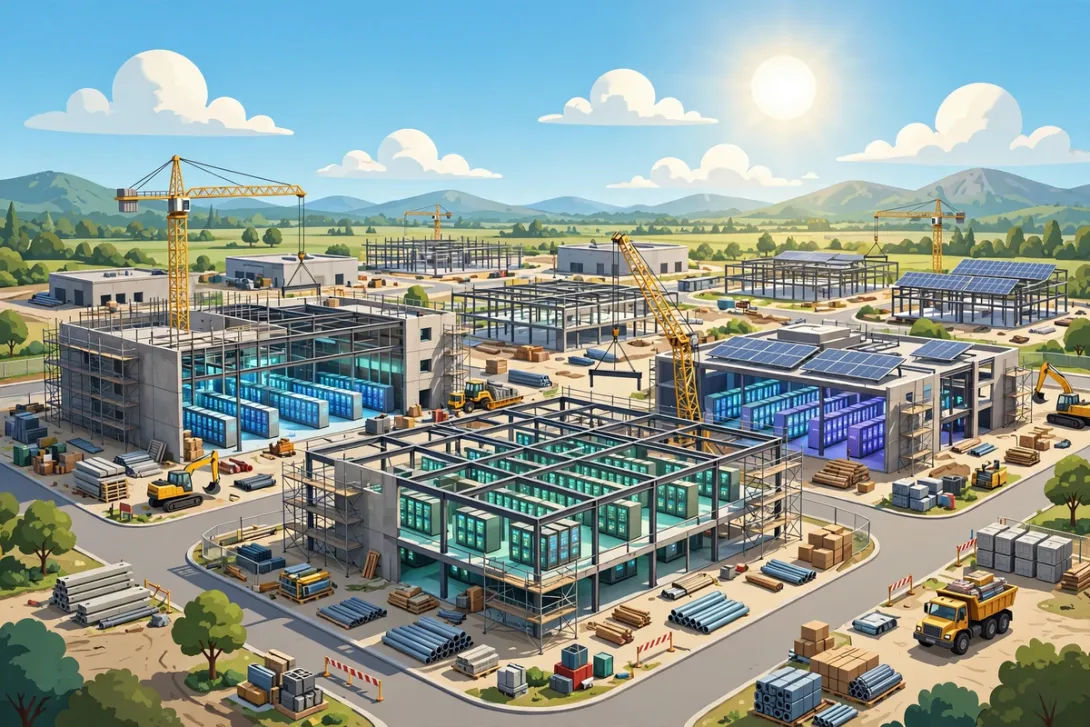
CoreWeave is taking its AI cloud to India. On October 8, the AI cloud infrastructure provider announced its entry into the Indian market through a collaboration with AdaniConneX, with plans to develop 240 megawatts of data center capacity in Navi Mumbai.
The planned campus will sit at AdaniConneX's Taloja data center campus and span three buildings of 80 megawatts each, with CoreWeave as the sole tenant across all three. The company plans to deploy Nvidia's Vera Rubin Platform on its AI Cloud infrastructure there, bringing next-generation computing to customers building advanced AI applications. The campus could eventually support an additional 240 megawatts, potentially doubling the initial capacity.
The first phase is expected to become operational in mid-2028, with additional capacity coming online in stages. The facilities are being designed specifically for high-density AI infrastructure: direct liquid cooling for GPU data halls and a non-evaporative chilled-water system, architected to accommodate future generations of AI computing hardware as requirements evolve.
The workloads targeted read like a catalog of modern AI demand: model training, inference, advanced reasoning, agentic AI, and high-performance computing. India is one of the world's fastest-growing markets for AI and digital infrastructure, and the move extends CoreWeave's AI Cloud platform into a region where hyperscalers and enterprises are racing to secure compute.
The announcement is part of a broader global land grab for AI-ready power. The same week saw Digital Realty break ground on a 24-megawatt AI facility in Osaka, Japan, and Bitdeer sign a 10-year agreement for a 67-megawatt campus in Malaysia, pushing its secured AI cloud capacity past 273 megawatts with a pipeline exceeding $10 billion. KT Cloud joined a 50-megawatt project in Incheon, South Korea, as part of a plan to deliver over a gigawatt of AI data center capacity across 20 sites by 2031.
For infrastructure planners, the pattern is unmistakable: AI capacity is being sited where power, land, and demand intersect, and the build-outs are measured in hundreds of megawatts with multi-year lead times. Enterprises planning AI initiatives for 2028 and beyond should be locking in capacity conversations now — the campuses being announced today are the compute their models will run on tomorrow.