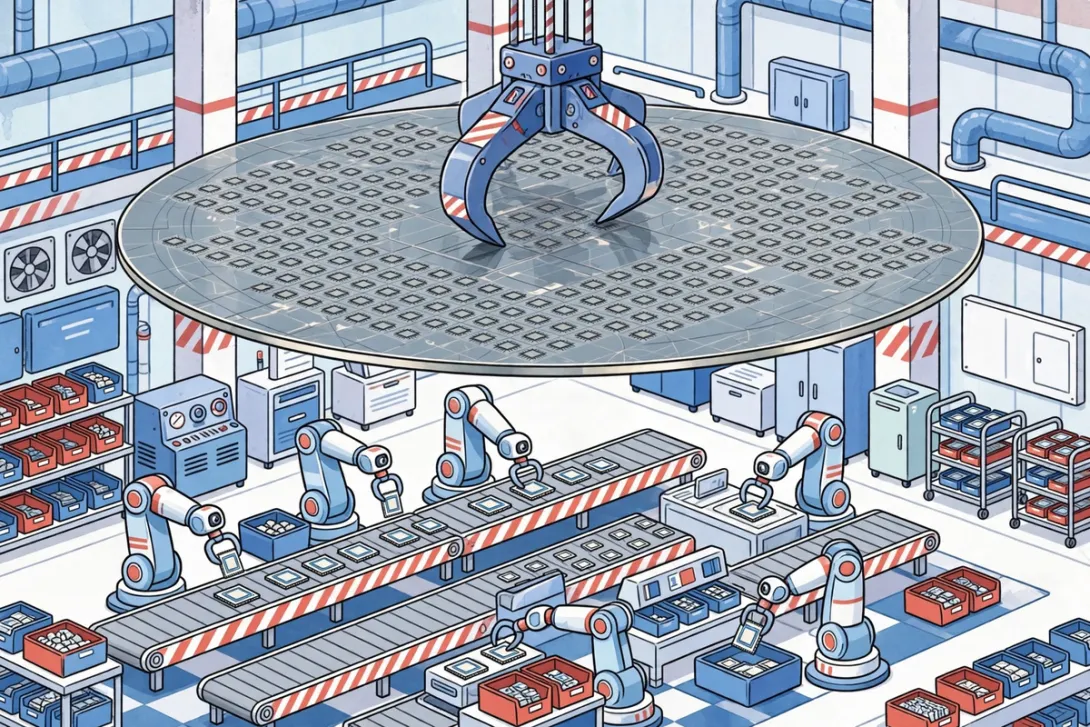
GlobalFoundries and TSMC are teaming up to bring a critical piece of the AI chip supply chain onto American soil. On October 8, GlobalFoundries announced a $2 billion, five-year manufacturing agreement under which it will produce silicon interposers for TSMC at its Malta, New York facility — making the site the first U.S.-based source of the components.
Silicon interposers rarely make headlines, but they are the unsung enablers of modern AI accelerators. These thin silicon substrates sit between the logic die and the memory stack in advanced packaging, routing thousands of high-speed connections that let GPUs and high-bandwidth memory talk to each other. As AI chips grow larger and hungrier, interposer capacity has become a genuine bottleneck — and nearly all of it sits in Asia today.
Under the deal, GlobalFoundries will expand capacity at its Malta fab to produce interposers, including embedded deep trench capacitor components built for demanding computing applications. Volume production is expected to begin ramping in the first half of 2028. "Advanced packaging is becoming increasingly critical to delivering the performance, power efficiency and scale required for next-generation AI systems," said Ed Kaste, senior vice president of CMOS Business at GlobalFoundries.
The agreement underscores how advanced packaging has moved from back-end afterthought to strategic asset. With leading-edge logic nodes facing diminishing returns, chipmakers increasingly squeeze performance gains from how dies are assembled rather than how small the transistors are. Owning interposer supply — especially domestic interposer supply — is now a competitive advantage for anyone building AI infrastructure.
The news landed alongside a reminder of just how hot the silicon market is. TSMC reported third-quarter revenue of $46.71 billion, up 50 percent year over year, with September revenue of approximately $16.03 billion. Industry data showed the global semiconductor market topping $1 trillion in annual sales for the first time, steaming toward $2 trillion on AI-driven demand for GPUs and memory. GlobalFoundries shares rose nearly 6 percent in morning trading on the announcement, bucking a broader market drawdown.
For enterprise IT leaders, the deal is a leading indicator rather than an immediate change: interposer capacity coming online in 2028 means the AI hardware supply crunch is being addressed structurally, but lead times for high-end accelerators will remain long for the foreseeable future. The strategic takeaway is geographic — Washington's push for domestic semiconductor capacity is now reaching deep into the packaging layer, not just the fabs themselves.